Sustainable Solutions for Egg Production’s Two Main Impact Areas
28 May 2026
Sustainability is a growing priority across the global egg sector, with producers continuing to innovate and invest in practices that reduce environmental impact while supporting efficient food production.
The environmental impact of egg production is mainly due to 2 key factors:
What goes in: Feed is up to 81% of total environmental impact 1, 2, 3.
What comes out: Manure is up to 46% of total footprint 2, 3.
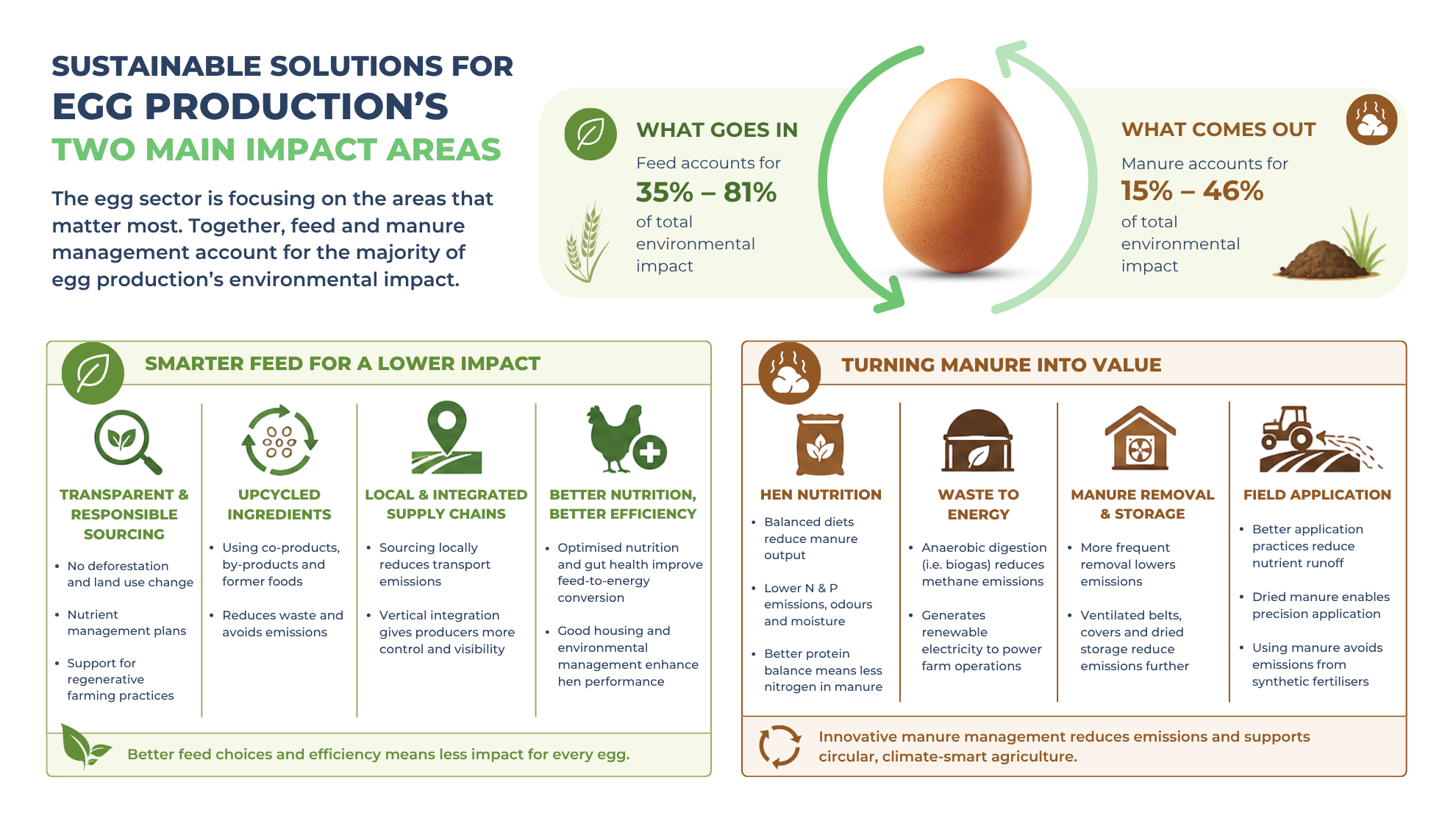
The egg sector is taking important steps to address these impact areas…
Feed Supply Chain Transparency
The global egg industry is increasingly focusing on feed supply chain transparency to ensure responsible and sustainable production. This includes working with suppliers that avoid deforestation and land use change, protect biodiversity and high conservation value ecosystems, and implement nutrient management plans and regenerative farming practices.
Some feed suppliers are also embracing circular agriculture by incorporating upcycled co-products, by-products and former foods into hen diets. Leveraging these materials in hen feed avoids the environmental impacts associated with growing feed crops and from sending these waste by-products to landfill. Research suggests that replacing soy with these alternative materials could reduce up to 60% of greenhouse gas (GHG) emissions from poultry diets 4.
Local sourcing is another important strategy, helping reduce transport-related emissions while supporting environmentally and socially responsible farming systems closer to home. Many egg producers are also now vertically integrated, giving them full control over the egg supply chain through their own operations.
 Feed-to-Energy Innovations
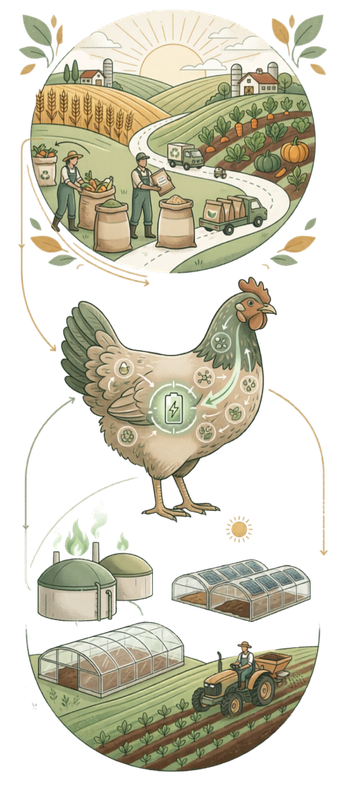
The egg sector is also focused on improving feed-to-energy conversion efficiency by optimising hen nutrition, gut health, housing conditions, and on-farm environmental controls.
Better efficiency means hens require less feed to produce nutritious eggs, reducing the impact of every egg produced.
Minimising Manure Emissions
Hen nutrition can also play a role in reducing emissions of highly potent GHGs, such as methane, from manure. Carefully balanced hen diets can lower manure production and reduce nitrogen, phosphorus, odours, and moisture levels.
Waste to Energy
Egg producers are increasingly investing in technologies and practices that transform manure into valuable resources, including renewable energy, biochar, and organic fertilisers. Through anaerobic digestion, manure can be converted into biogas, reducing methane emissions while generating renewable electricity that can power farm operations.
Removal, Storage & Application
On-farm manure management improvements, including increasing the manure removal frequency from hen housing and manure belts, also mitigate emissions. This is because the manure emission factor increases with longer residence times.
Innovations in manure drying, storage, and field application are also helping minimise emissions and reduce risks. Dried manure pellets can improve precision fertiliser application, supporting crop growth while reducing the need for synthetic fertilisers.
Supporting a Sustainable Future
Across the egg value chain, producers are demonstrating how innovation, collaboration, and continuous improvement can support more sustainable food systems. By focusing on feed efficiency, responsible sourcing, and circular manure management, the global egg sector is helping build a more resilient and resource-efficient future for agriculture.
References
1 Guillaume, A., Hubatová-Vacková, A., and Kočí, V. [2022]. Environmental Impacts of Egg Production from a Life Cycle Perspective. 12(3): 355. https://doi.org/10.3390/agriculture12030355
2 Pelletier, N. [2017]. Life cycle assessment of Canadian egg products, with differentiation by hen housing system type. 152: 167-180. http://dx.doi.org/10.1016/j.jclepro.2017.03.050
3 Turner, I., Heidari, D., and Pelletier, N. [2022]. Life cycle assessment of contemporary Canadian egg production systems during the transition from conventional cage to alternative housing systems: Update and analysis of trends and conditions. 105907. https://doi.org/10.1016/j.resconrec.2021.105907
4 Taylor, R.C., Omed, H., Edwards-Jones, G. [2014]. The greenhouse emissions footprint of free-range eggs. 93:231–237. https://dx.doi.org/ 10.3382/ps.2013-03489
Spread the word!
WEO has developed a social media toolkit to help you celebrate World Environment Day 2026 with eggs. The toolkit includes specially made sample graphics, video and post suggestions for Instagram, Facebook and X, all ready to be downloaded and shared!
Download the World Environment Day toolkit (English)
Download the World Environment Day toolkit (Spanish)